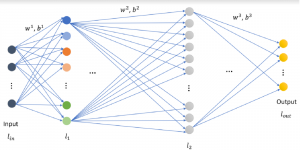


As deep neural networks grow in size and demand, analog neural network accelerators have emerged as a promising path toward energy-efficient inference. By performing multiply-accumulate (MAC) operations directly in the analog domain, they avoid much of the data movement and conversion cost of digital hardware. However, analog circuits are sensitive to process, voltage, and temperature (PVT) variations, and the resulting computational errors can severely degrade model accuracy, especially in large-scale MAC arrays with thousands of multipliers.
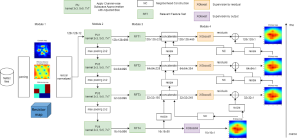
In this work, we identify weight perturbation and differential pair mismatch as the primary error sources in analog accelerators, where mismatch appears as gain error and offset error. We find that these errors behave differently and therefore require different solutions. On the algorithm side, perturbation-aware training methods such as sharpness-aware minimization (SAM/ASAM) make the network robust to weight perturbation and gain error. Offset error, however, is injected at every layer and resists such regularization. On the hardware side, we therefore propose single-cut chopping, which periodically inverts signal polarity so that offset is cancelled when the two phases are averaged. This adds only 7.84% energy overhead while enabling about 25x smaller analog multipliers. Together, the co-design maintains accuracy under large PVT variations across multiple network architectures, where either approach alone fails.