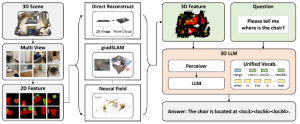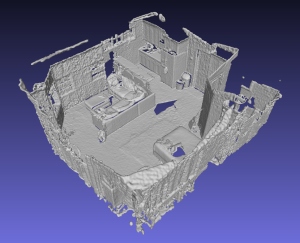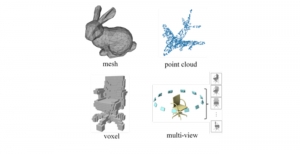


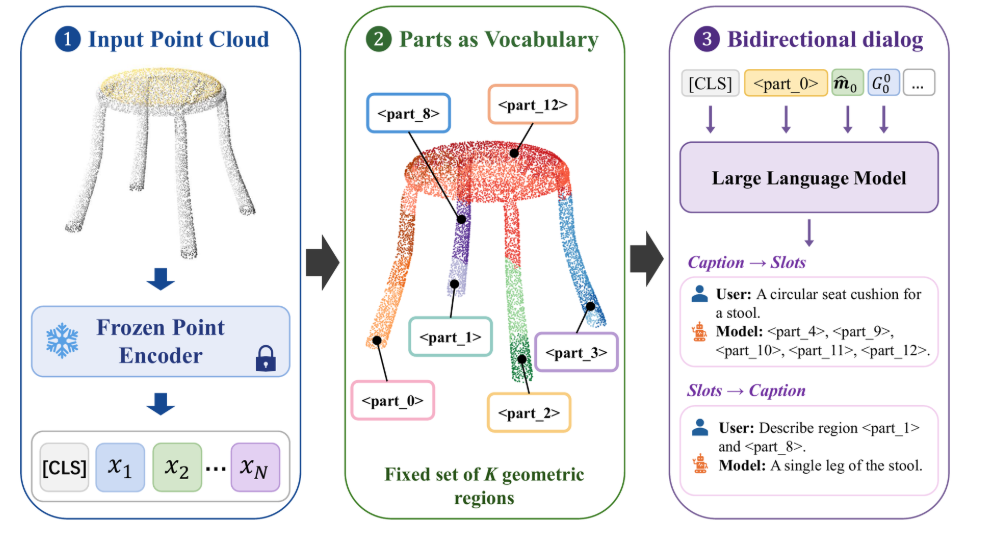
Models like PointLLM can describe a chair from its point cloud, but they struggle to identify specific parts, such as the back or legs. This is because the language model processes the object as a single, flat stream of tokens, none of which represent individual parts. Previous part-aware systems have relied on adding a segmentation decoder or a more complex encoder, which significantly increases the number of parameters, while parts remain outside the model’s vocabulary.
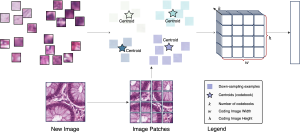
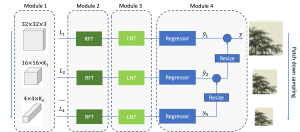
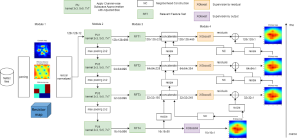
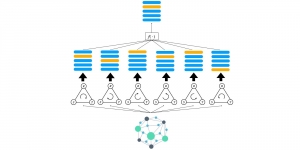
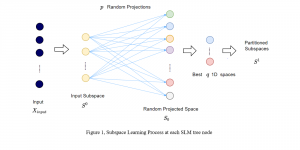
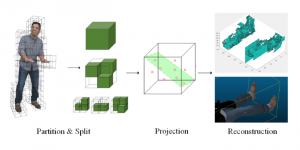
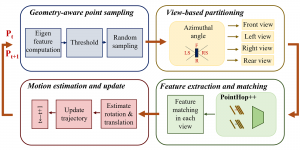
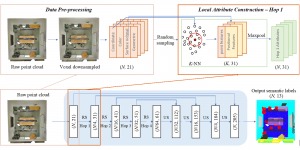
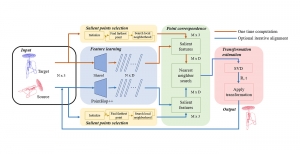
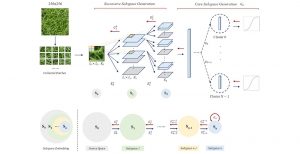
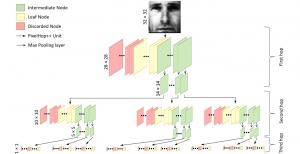
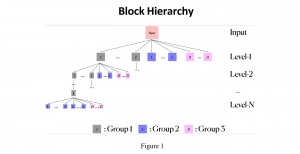
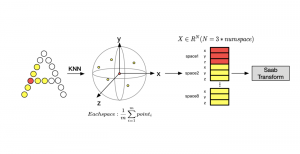
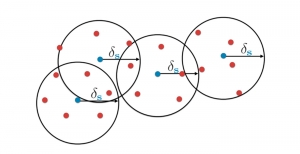
Our approach, 3D-PLOT-LLM, reorganizes the input tokens. We implement a training-free step that divides the frozen point encoder’s patch tokens into spatially coherent regions. Before each region, we insert a learnable marker and a reserved vocabulary token. A compact module, called Marker-Space Refinement, conditions each marker based on its region’s position, size, and neighboring regions. This allows the language model to process part tokens similarly to how it processes words: when a part is named, the model returns its tokens; when tokens are provided, the model describes the corresponding region. Notably, we achieve this with fewer than one million additional parameters and without the need for a segmentation decoder.
We developed PartVerse-QA using public annotations from PartVerse aligned with the Objaverse point clouds that PointLLM utilizes. Our model grounds part descriptions in region tokens and achieves improved text-description scores on the 3DCoMPaT-GrIn part-description benchmark, outperforming PointLLM and several other part-aware systems. Furthermore, performance on whole-object captioning on Objaverse remains at or above that of PointLLM. The paper has been accepted to NeurIPS 2026. The code, weights, and data are publicly available at [GitHub](https://github.com/jintangxue/3D-PLOT-LLM).